Choosing façade materials for your build determines how a building looks, how it performs, how much it costs over time and how confidently you can meet construction compliance requirements. In Australian construction today, two popular choices are aluminium and fibre cement cladding. This guide walks through the key differences between fibre cement vs aluminium cladding and helps you decide which is right for your project.
Fibre Cement Cladding vs Aluminium Cladding – Key Differences Explained
Here’s a quick comparison to help outline how these two systems stack up:
| Feature |
Aluminium Cladding |
Fibre Cement Cladding |
| Weight |
Lightweight - well-suited where reducing structural load is important |
Heavier; typically requires greater structural support |
| Fire Performance |
Non‑combustible options available (FR or A2 cores) |
Non‑combustible by nature |
| Design Flexibility |
Very high; virtually unlimited colour and finish options. Panels can be fabricated, folded, and curved |
Moderate; wide range of colours and finishes, generally matte or concrete‑like in appearance |
| Durability |
High - performance is dependent on coating quality and core type |
Very high - inherently robust and long‑lasting |
| Impact Resistance |
Moderate - panels may dent, though coatings can provide scratch and graffiti resistance |
High - strong resistance to impact and vandalism |
| Installation Speed |
Typically faster due to lightweight panels and modular systems |
Slower due to panel weight and board handling |
| Maintenance |
Low maintenance - depends on coating durability |
Low maintenance - painted surfaces may be more prone to chipping |
| Acoustic Performance |
Limited - relies on backing insulation |
Better inherent acoustic performance due to higher mass |
| Climate Performance |
Excellent – requires appropriate coatings and detailing to resist corrosion in coastal and humid conditions. |
Excellent – inherently stable in coastal and humid environments; edge sealing and detailing manage moisture exposure. |
| Sustainability |
Aluminium is recyclable -the overall environmental impact is influenced by the core material |
Cement‑based material with a long lifespan, though higher embodied carbon |
| Typical Applications |
Commercial buildings, retail spaces, high‑end residential, and architectural feature façades |
Schools, residential and commercial buildings, industrial and high‑traffic applications |
What Is Aluminium Cladding?
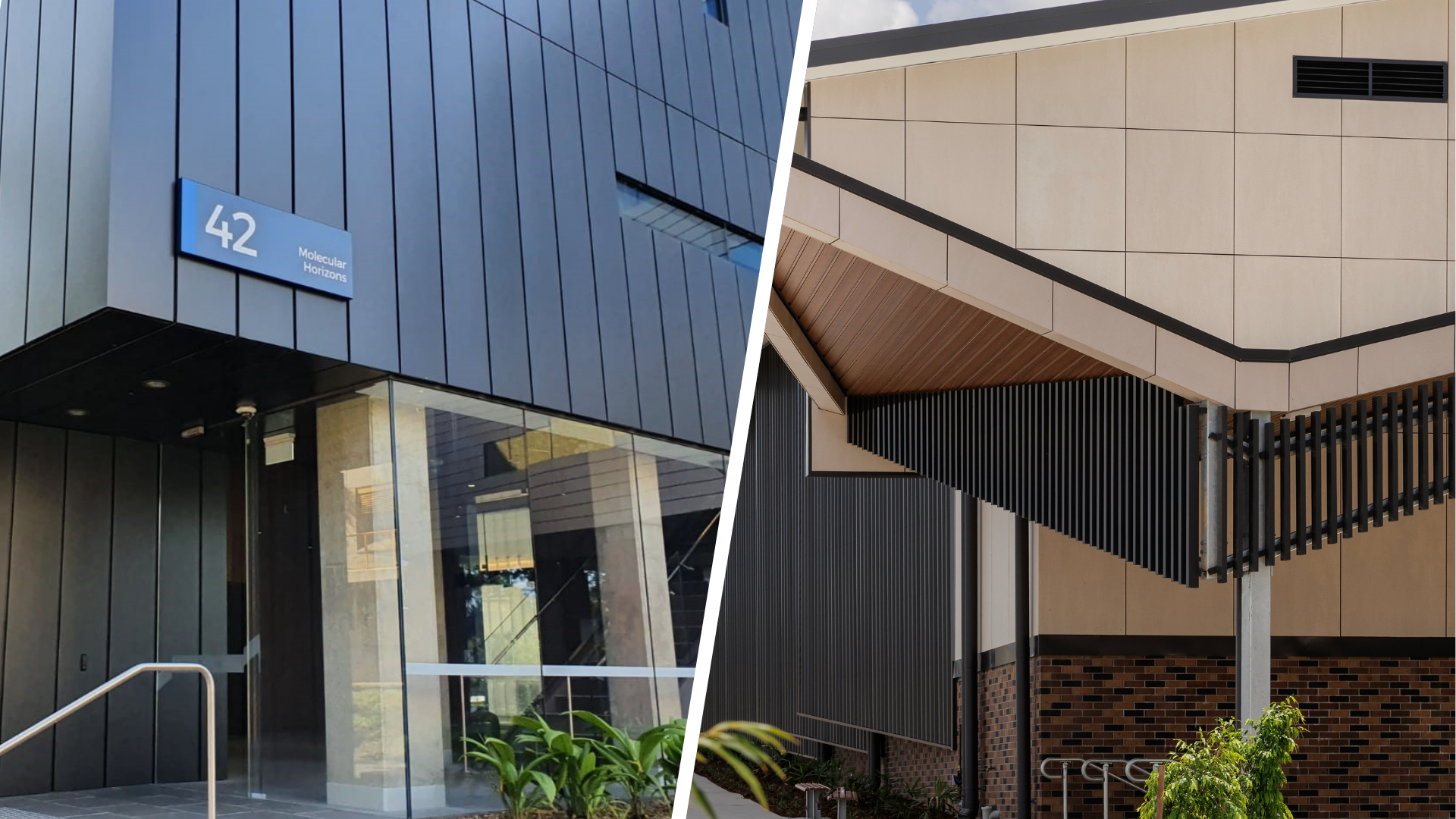
Aluminium cladding refers to external façade systems manufactured from aluminium either as engineered composite panels or solid aluminium cassettes. These systems are designed to clad the external walls of buildings, providing a protective, decorative and performance-driven skin.
Specifiers often turn to aluminium for its combination of performance, durability and design flexibility. As a lightweight cladding, it places less load on structures, which is particularly advantageous in multi-storey or high-rise buildings where structural weight is a key consideration.
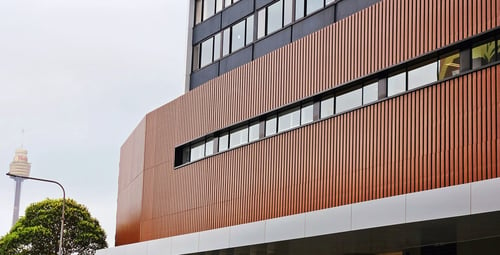
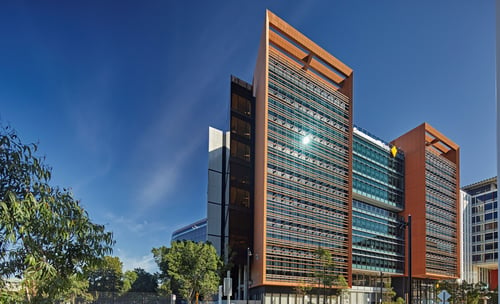
One widely used solution in this category is Fairview’s Vitracore G2 engineered aluminium cladding panels, which deliver design flexibility, a wide range of finishes, and cladding performance backed by CodeMark certification.
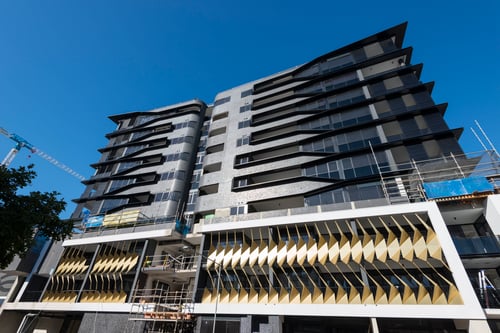
Another notable product is Vitradual solid aluminium cassette cladding, a non-combustible façade system with high impact resistance and decorative finish options.
Benefits of aluminium cladding include:
- Excellent corrosion resistance, ideal for coastal environments
- Long-lasting durability with minimal upkeep
- Design flexibility across colours and finishes
- Proven cladding for high-rise building applications.
Because products like Vitracore G2 and Vitradual are engineered to meet stringent non-combustibility requirements, they are commonly specified for external wall cladding Australia-wide where safety and compliance are non-negotiable.
What Is Fibre Cement Cladding?
Fibre cement cladding is a façade product made from a mixture of cement, cellulose fibres, sand and water. It is compressed and cured to form rigid panels or boards, which are then fixed to external walls as a durable, stable surface.
Unlike aluminium, fibre cement is inherently dense and non-combustible, making it a trusted choice for projects where fire performance is a priority. Fairview’s solution in this space is the Genesis fibre-cement cladding system, a range of pre-finished, through-coloured panels designed for modern cladding applications.
Key characteristics of fibre cement cladding:
- Non-combustible by material composition
- Resistant to impact and environmental exposure
- Consistent, clean façades suitable for many design styles
- Long-term durability with low required maintenance
Fibre cement remains a common façade material for education and civic projects, particularly when robustness and code compliance are prioritised.
Fire-Rated Cladding & Compliance: What the NCC Says
For builders and specifiers, one of the most crucial factors when choosing cladding is fire performance. Under the National Construction Code (NCC), certain building types and heights require non-combustible cladding materials and documentation demonstrating compliance with NCC fire-rated cladding requirements.
Both aluminium and fibre cement cladding can meet non-combustibility requirements when selected and installed as part of a compliant system:
- Fibre cement’s composition makes it inherently non-combustible.
- Systems like Fairview’s Vitracore G2 and Vitradual carry certifications confirming they meet non-combustibility criteria and can be used where non-combustible cladding is required.
Being clear on these standards early in the specification phase prevents costly redesigns and ensures smoother project approvals.
How Lightweight, Low-Maintenance Cladding Performs in Harsh Climates
Many projects in Australia contend with extreme conditions, from tropical humidity to salty coastal air. When assessing how materials will perform, consider:
- Weather resistance
- Longevity
- Ease of maintenance
Aluminium cladding excels in corrosive or humid environments. It is inherently rust-resistant and requires minimal maintenance, making it a strong match for coastal developments and large-scale buildings.
Fibre cement cladding also performs well outdoors, but its heavier nature means moisture management through design detailing (like effective cavity ventilation) is an important consideration to avoid long-term issues.
Both choices can be part of sustainable cladding options, particularly when they reduce lifecycle maintenance and support responsible procurement goals. Fairview’s Vitradual and Vitracore G2 are backed by Global GreenTag’s GreenRate Level A certification, while Fairview’s Genesis is supported by an Environmental Product Declaration (EPD), providing transparent sustainability and environmental impact data.
Which Cladding Is More Cost-Effective Long-Term?
Upfront material costs are important, but lifecycle value often drives smarter decisions:
- Aluminium cladding often has a higher initial cost per square metre but benefits from quicker installation, reduced labour and less maintenance over time.
- Fibre cement cladding may be more economical initially, but can incur higher handling and installation costs due to its weight.
When evaluating cost, consider:
- Installation time and labour
- Expected service life
- Maintenance and refurbishment cycles
- Warranty and performance assurances
These factors are essential for determining true cost-effectiveness over the entire building lifecycle.
When to Choose Aluminium or Fibre Cement Cladding
Here’s a quick guide for different project needs:
Choose aluminium cladding when:
Choose fibre cement cladding when:
- Specifying high-traffic or high-use areas
- A high-end aesthetic with long-term durability is important
- Heavier panel systems support the architectural intent and can contribute to acoustic and thermal performance
- A textured or biophilic aesthetic is preferred
Each has a place in delivering compliant, high-performing façades — especially when paired with proper detailing and installation.
Explore Fairview’s Cladding Solutions
Fairview offers a comprehensive suite of façade materials tailored to modern construction demands. Whether you need advanced aluminium façade systems like Vitracore G2, solid aluminium cassette solutions like Vitradual, or robust fibre-cement options like Genesis, there’s a solution engineered for performance and compliance.
To explore specifications, request samples or learn which system best fits your project, contact Fairview’s technical team and make your next façade both beautiful and built to last.