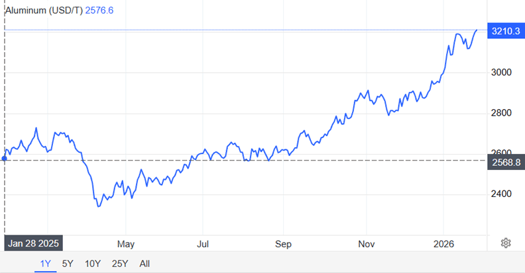
Aluminium prices have continued to rise over the past year, increasing from USD 2,569 per tonne in January 2025 to USD 3,210 per tonne in January 2026. This marks a 25% year‑on‑year increase, underscoring a market that has tightened considerably.
The shift hasn’t been steady. After easing in early Q2 2025, prices rebounded quickly through Q3 and Q4 and have carried that momentum into 2026. The trend is being driven by a combination of supply challenges, strong sector demand and heightened market activity.
Key Drivers Behind the Increase:
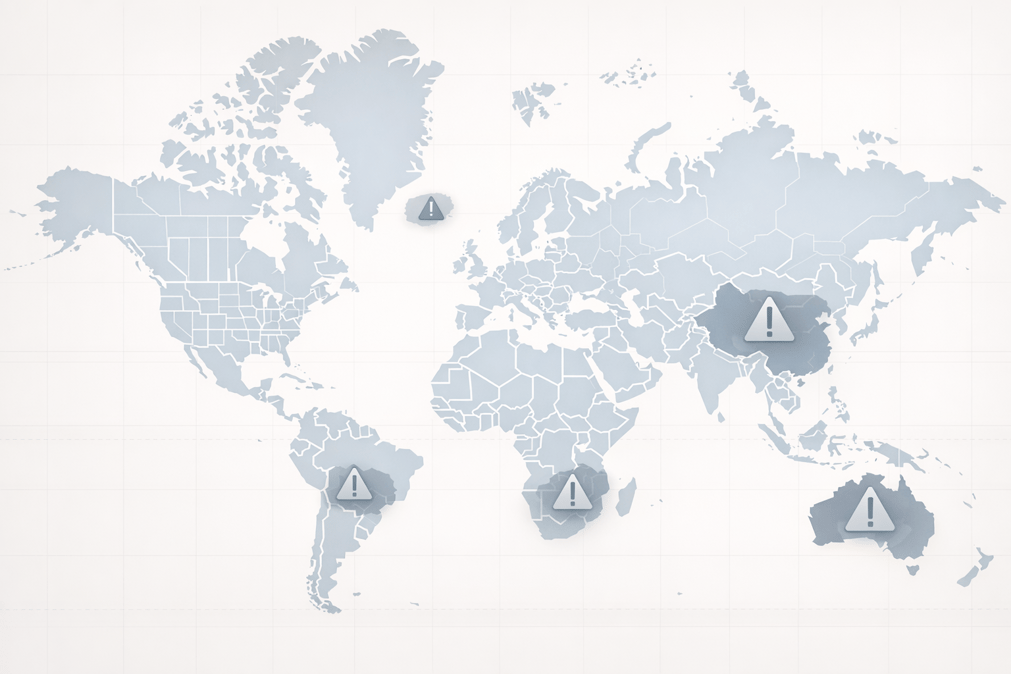
- Global supply remains stretched as production caps, smelter outages and rising power costs continue to limit output, particularly in China, Iceland, Mozambique and Australia.
- Increased demand from key sectors, with renewables, electric vehicles, construction and packaging all contributing to higher consumption.
- Global capacity expansion has fallen behind schedule, with Indonesian smelting projects delayed by regulatory and energy challenges.
- Market dynamics and trading activity have intensified, with increased hedging and speculative trading amplifying price movements on major futures exchanges.
1. Global Supply
Although China reached record aluminium output in 2025, the government‑imposed 45‑million‑ton production cap has prevented additional capacity from coming online. This cap remains a major limiting factor, keeping supply tight even as global demand increases. At the same time, smelters in Iceland, Mozambique and Australia faced various operational issues throughout 2025, reducing overall output during a period of heightened need. Energy costs have added further pressure. Aluminium smelting is extremely power‑intensive, and rising electricity prices across Asia have restricted production at several key facilities. Collectively, these conditions have limited the amount of aluminium available on the global market, contributing to sustained upward pressure on price.
2. Increased Demand from Key Sectors
Growth across several key sectors has significantly increased aluminium consumption. The renewable energy industry alone has developed a heavier appetite for aluminium, relying on it for solar panel frames, wind turbine components and transmission infrastructure. At the same time, the electric vehicle market continues to expand rapidly. As more manufacturers shift towards lighter materials to improve efficiency and meet emissions targets, aluminium remains essential for structural components and battery casings. Traditional industries have remained steady contributors as well. Construction activity throughout 2025 remained solid, and the packaging sector maintained consistent usage. With demand rising across so many areas simultaneously, the market has struggled to accommodate the additional load, further driving prices higher.
3. Delayed Global Capacity Expansion
Global supply growth has also been impacted by delays in new smelting capacity outside China. Expansion projects in Indonesia, intended to help diversify global aluminium production, have encountered ongoing regulatory hurdles and energy availability issues. These challenges have slowed progress and prevented new supply from entering the market as originally planned. With no immediate relief from these developments, the supply shortfall persists, driving higher aluminium prices.
4. Market Dynamics and Trading Activity
Beyond physical supply and demand, financial market behaviour has played a notable role in recent pricing trends. Major exchanges, including the LME, SHFE and COMEX, have seen an uptick in both hedging activity and speculative trading as participants respond to market uncertainty. This heightened trading volume, combined with already tight supply conditions, has made price movements more pronounced. As volatility increased through Q3 and Q4 of 2025, futures activity contributed to both sharp upward swings and sustained higher pricing.
Outlook for 2026
With supply restraints, persistent demand and continued volatility across global markets, aluminium prices are expected to remain elevated through the short to medium term.
Given these conditions, Fairview will implement price increases across its aluminium product range. Customers are encouraged to speak with their Fairview representative to discuss upcoming adjustments and available options for managing stock requirements.
Get In Touch.