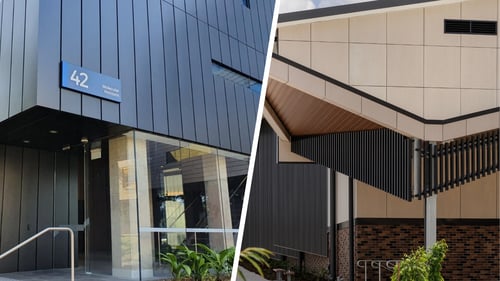
Of all the NCC 2025 updates affecting building envelopes, condensation management is likely to have the greatest impact on facade design.
The introduction of mandatory drained and ventilated cavities in Climate Zones 6, 7 and 8 reflects growing industry recognition that moisture management plays a critical role in building durability and performance. The code also expands vapour permeance requirements and introduces new provisions for cavity ventilation and drainage.
Why this matters
Moisture trapped within a wall assembly can contribute to:
- Corrosion of structural elements
- Reduced insulation performance
- Mould growth
- Material degradation
- Long-term building defects
NCC 2025 addresses these risks by requiring wall assemblies to actively manage moisture movement and drying potential.
For rainscreen facade systems, these requirements align closely with long-established design principles. Drained cavities, rear ventilation and pressure moderation have formed the foundation of rainscreen performance for decades.
Where auditors are focusing
One of the most common misconceptions is that cavity compliance is simply a question of cavity depth.
In practice, auditors are increasingly examining whether the cavity functions as intended.
That includes:
- Continuous drainage pathways
- Ventilation openings at the top and bottom of the wall
- Membrane selection
- Transitions around slab edges
- Fire-stopping interfaces
- Bracket and support locations
Projects often encounter compliance issues when cavity barriers, fire-stopping products or construction tolerances interrupt airflow or drainage pathways that were originally incorporated into the design.
For facade contractors and builders, the detail matters just as much as the cavity itself.
NCC 2025 Reinforces a Performance-Based Approach to Water Management
One of the less publicised but highly significant changes within NCC 2025 is the consolidation of previous Parts F1 and F3 into a single Water Management framework. The revised provisions now address both surface water and sub-surface moisture through a more holistic performance approach.
At first glance, this may appear administrative.
In reality, it reflects an important shift in how water management is viewed within modern buildings.
Water will enter the facade. The system must manage it.
Traditional discussions around weatherproofing often focused on preventing water ingress altogether.
Modern rainscreen design acknowledges a different reality.
Under severe weather conditions, wind-driven rain can bypass the outer cladding layer. Building performance relies on how effectively the wall assembly manages, drains and redirects that moisture.
A properly designed rainscreen facade achieves this through multiple layers of protection:
- The external cladding sheds the majority of water.
- The cavity provides drainage and ventilation.
- The membrane protects the primary structure.
- Flashings redirect water safely back to the exterior.
This layered approach closely aligns with the water-management objectives reinforced within NCC 2025.
What this means for project teams
The biggest impact is likely to be felt through documentation.
Specifications, installation guides, technical manuals and compliance references should be reviewed to ensure alignment with the updated clause structure and terminology.
Projects in NSW should also verify transitional arrangements, as some existing-building work may continue to reference NCC 2022 Amendment 2 provisions.
Fire Compliance Is Increasingly About Traceability
Fire compliance remains one of the most scrutinised aspects of any facade audit.
However, the conversation has evolved significantly since the combustible cladding crisis.
The emphasis today is on evidence.
Auditors want to understand:
- What was specified?
- What was delivered?
- What was installed?
- What evidence supports compliance?
This places greater importance on product traceability, procurement control and documentation management throughout the construction process.
Compliance is assessed at a system level
Auditors assess the entire wall assembly, including:
- Cladding panels
- Support framing
- Fixings
- Sarking
- Insulation
- Fire-stopping products
- Installation methodology
Evidence of compliance may include AS 1530.1 reports, NATA-accredited testing, engineering assessments and project-specific documentation supporting the chosen compliance pathway.
For suppliers, maintaining clear batch records and traceable compliance documentation is becoming increasingly important across both new-build and rectification projects.
Why AS 4284 Matters More Than Ever
One of the most important industry shifts in recent years has been the move from component-based compliance toward system-based performance verification.
This is particularly relevant for facade audits.
A compliant panel does not automatically create a compliant facade.
Performance depends on how panels, framing systems, membranes, flashings and interfaces perform together as a complete assembly.
AS 4284 testing provides valuable evidence that a facade system has been assessed under simulated wind and weather conditions, helping validate:
- Water penetration resistance
- Structural performance
- Serviceability performance
- Building envelope integrity
For auditors, system testing offers confidence that the documented design has been assessed as a complete facade solution rather than a collection of individual components.
The Five Audit Findings We Expect to See Most Often in 2026
Based on the direction of NCC 2025 and current industry trends, several recurring themes are emerging.
1. Blocked cavity drainage
Many wall systems include compliant cavity designs on paper. Audit findings frequently occur where fire barriers, packers, brackets or construction modifications restrict drainage pathways.
2. Incomplete evidence of suitability
Projects often possess some of the required documentation but not enough to support the installed configuration.
3. Product substitutions
Substituted membranes, fixings, insulation products and sub-framing systems can invalidate documented compliance pathways.
4. Missing traceability records
Supporting documentation is significantly stronger when materials can be linked directly to batch records, test reports and delivery documentation.
5. Limited installation verification
Photographs, hold-point inspections, QA sign-offs and installation records are becoming increasingly valuable during audits.
Each of these issues is preventable when compliance documentation is maintained throughout the project lifecycle rather than assembled shortly before certification or audit.
Audit Readiness Starts During Design
The strongest audit outcomes are typically established long before construction begins.
When facade systems are selected early and supported by documented compliance pathways, project teams gain greater confidence through procurement, installation and certification.
Technical collaboration during design assists with:
- System selection
- Specification development
- Evidence of suitability
- Product traceability
- Installation planning
- Audit preparation
For rainscreen facade systems, early coordination also helps integrate fire safety, water management, condensation mitigation, structural performance and constructability requirements within a single documented solution.
The Fairview Perspective
Many of the changes introduced under NCC 2025 reinforce principles that have long underpinned high-performance rainscreen facade design.
Effective cavity ventilation, moisture management, system testing, documented compliance pathways and installation quality are no longer niche technical considerations. They are becoming central components of audit readiness.
At Fairview, we support project teams with tested rainscreen facade systems, technical documentation, evidence of suitability, compliance guidance and project-specific support throughout the design and construction process.
As audit requirements continue to evolve, the projects best positioned for compliance will be those that treat facade performance as a complete system, supported by clear documentation, verified installation practices and a well-managed compliance pathway from design through to handover.