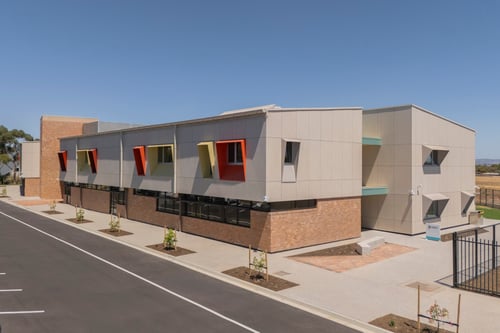
Fibre cement cladding is exposed to ultraviolet (UV) radiation from the day it is installed. Alongside moisture, temperature fluctuations and other environmental conditions, UV exposure contributes to the weathering processes that influence how a facade appears over time.
Understanding UV performance helps establish how fibre cement cladding is expected to retain its appearance and colour under prolonged environmental exposure.
What Is UV Performance?
UV performance refers to a material's ability to withstand prolonged exposure to ultraviolet (UV) radiation from the sun while maintaining its appearance and surface integrity.
UV radiation carries enough energy to break down certain chemical bonds within materials over time. Depending on the material composition, this process can contribute to colour fade, surface chalking, discolouration or other visible signs of weathering.
While UV exposure is often discussed in isolation, it is just one part of a broader weathering process. Facade materials are simultaneously subjected to moisture, temperature changes, pollutants and varying environmental conditions, all of which influence long-term appearance.
No exterior material remains completely unchanged throughout its service life. The key difference lies in how materials respond to these conditions, how quickly visible changes occur and whether those changes remain within acceptable aesthetic expectations.
Why Does UV Performance Matter in Fibre Cement Cladding?
While all exterior materials experience weathering, the rate and visibility of that change varies significantly between products. In facade applications where colour consistency, architectural detail and long-term aesthetics are priorities, UV performance becomes a critical specification criterion.
The impact is particularly important for large-format facades where subtle colour shifts can become noticeable across broad elevations due to the scale and continuity of the facade surface. In commercial, education and multi-residential projects, maintaining a consistent appearance can influence asset value, tenant perception and long-term maintenance planning.
Many fibre cement products incorporate pigment during manufacturing, creating a through-coloured board where colour extends throughout the panel rather than being applied solely as a surface coating. In these products, colour stability is closely linked to the material's ability to resist the effects of UV exposure. Because colour forms part of the board itself, colour stability provides a measurable indication of how effectively the material retains its appearance over time. UV performance therefore plays an important role in assessing the long-term visual performance of through-coloured fibre cement cladding.
As fibre cement is commonly selected for projects requiring long service life and durable exterior performance, understanding how colour and surface appearance may change over time forms an important part of evaluating overall facade performance.
The Relationship Between UV Performance and Colour Stability
One of the most visible indicators of UV performance is colour stability.
Colour stability describes a material's ability to maintain a consistent appearance following prolonged exposure to sunlight and weather. As UV radiation interacts with pigments over time, gradual colour change can occur. The degree of change depends on factors including pigment formulation, material composition and environmental conditions.
For fibre cement facades, colour stability contributes to the overall weathering profile of the material. Measuring colour change allows manufacturers and specifiers to better understand how products may perform over extended periods of outdoor exposure.
For building owners, this can translate into lower lifecycle maintenance requirements and greater confidence that the facade will continue to reflect the building's original design vision years after completion.
What Factors Influence Long-Term Facade Appearance?
A facade's appearance is shaped by more than sunlight alone. Several environmental and design factors contribute to how exterior materials age over time, including:
- UV exposure and intensity
- Rainfall and moisture cycles
- Temperature fluctuations
- Coastal environments and salt exposure
- Airborne pollutants
- Building orientation
- Levels of shading from surrounding structures
The combination and intensity of these factors varies significantly between locations and building elevations, influencing how facade materials weather over time.
How UV Performance Is Measured
UV performance is commonly assessed through accelerated weathering and UV ageing tests conducted under controlled laboratory conditions.
These tests expose materials to concentrated UV radiation over extended periods, enabling long-term performance characteristics to be evaluated within a practical timeframe.
One of the most widely used methods for assessing colour stability is Delta E (ΔE), an industry-standard measurement that quantifies colour variation between two samples.
As a general guide:
- ΔE below 1.0 is considered imperceptible to the human eye.
- ΔE between 1.0 and 2.0 is generally considered barely perceptible.
- Higher values indicate increasingly noticeable colour variation.
While laboratory testing cannot replicate every real-world environment, it provides a consistent and measurable method for evaluating colour stability and UV performance.
UV Performance in Practice: Genesis NXG
The importance of UV performance can be demonstrated through the testing of Genesis NXG, the CEM II evolution of the Genesis Raw, Hewn and Groove profiles. Genesis NXG darkest colours delivered a 50-70% improvement in UV and colour stability compared with traditional CEM I cladding formulations, demonstrating a high level of colour stability after extended UV exposure. For a through-coloured fibre cement product, this represents strong performance against recognised industry benchmarks for visible colour change.
For more information on Genesis NXG, check our our CEM I to CEM II whitepaper.

.png?width=500&name=Fibrefast%20-%20film%20project%20(update).png)